
There’s something oddly emotional about holding a tiny piece of cardboard that somehow feels heavier than it should. The first time someone opens a pack from the Pokémon Trading Card Game, it’s rarely just “opening cards.”
It’s more like opening a memory that hasn’t happened yet. The smell of fresh cardstock, that slightly glossy shine, and then boom a Charizard staring back like it owns the universe. Strange how a 2.5 × 3.5 inch rectangle can mess with your brain like that.
People don’t usually talk about it, but the size of a Pokémon card is part of the magic. Not the artwork alone, not just rarity or hype, but the exact physical feel in your hand. Too big, it wouldn’t shuffle right. Too small, it wouldn’t feel real.
And somehow, since the 1996 Base Set (Pokémon TCG Base Set, 1996 launch set) era, it has stayed almost stubbornly consistent, like the world agreed: “Yep, this is the shape of nostalgia now.”
And yeah, maybe it’s just cardboard. But also… it’s not.
| Feature | Specification |
|---|---|
| Standard Size | 2.5 × 3.5 inches (63.5 × 88.9 mm) |
| Thickness | ~0.012 inches (0.305 mm) |
| Weight | ~1.78 grams |
| Aspect Ratio | 5:7 |
| Corner Radius | ~3.18 mm |
| Card Material | Printed cardstock (multi-layer paperboard) |
| Standard Use | Pokémon Trading Card Game |
| Compatibility | Fits standard sleeves, binders, toploaders |
| Oversized Cards | ~5 × 7 inches (promo/display only) |
| Print Consistency | Standardized across modern sets |
Pokémon Card Size: The small rectangle that quietly built a global obsession
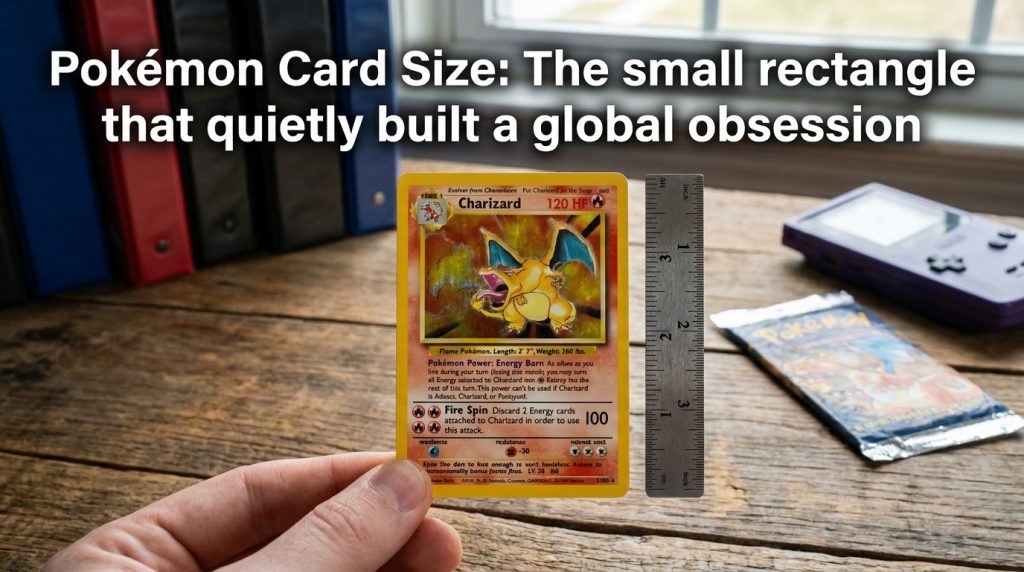
The standard Pokémon card size is one of those things people don’t think about until they absolutely have to. Every official card in the Pokémon Trading Card Game follows a strict physical template that keeps the entire ecosystem stable like a hidden rule holding the universe together.
The standard trading card dimensions are:
- 2.5 × 3.5 inches (63.5 × 88.9 mm)
- Thickness around 0.012 inches (0.305 mm)
- Weight approximately 1.78 grams
- Corner radius roughly 3.18 mm
- Aspect ratio close to 5:7
It sounds ultra precise because it is. Even a tiny deviation and suddenly your deck won’t shuffle right, or your sleeve won’t fit properly, and everything starts feeling… off.
This consistency isn’t just for Pokémon. It’s a shared language across many collectible systems like Magic: The Gathering, Yu-Gi-Oh!, and even KeyForge, though each has its quirks. But Pokémon really leaned into that uniformity like it was a sacred rule carved into cardstock.
And honestly, it kinda is.
Pokémon Card Size: Dimensions, details, and why your fingers care more than your brain
If you ever wonder why Pokémon cards feel so satisfying to hold, it’s not imagination. It’s engineering. The cardstock quality standards, printing consistency, and exact trading card size in inches are tuned for tactile comfort.
There’s something about that 63.5 × 88.9 mm rectangle that fits between fingers like it was designed by someone who spent too much time shuffling cards in the dark. Maybe they did.
The thickness matters more than people think. At roughly 0.305 mm, it’s thin enough to bend slightly during a shuffle but thick enough to resist turning into sad paper confetti after a few trades in a schoolyard. The balance is weirdly perfect.
Collectors often obsess over card thickness measurement, especially when dealing with rare pulls like a holographic Charizard or older prints from the Base Set era. Even a minor difference can hint at reprints or, in worst cases, counterfeit copies.
And don’t even get started on card weight grams Pokémon discussions in collector forums people will argue about fractions like it’s a philosophical debate.
A collector once said (half-joking, half-dead serious):
“If the card feels wrong in my hand, it’s already wrong in my heart.”
Bit dramatic… but also, not wrong.
Why Pokémon Card Size matters in the Pokémon Trading Card Game ecosystem
In the Pokémon Trading Card Game, size isn’t just about physical comfort it’s about gameplay integrity.
Deck building depends on uniformity. Shuffling mechanics depend on consistency. Tournament legality depends on strict standardization. If one card were slightly larger or heavier, it would subtly influence probability, stacking, or even how it sits in a deck.
The categories of cards Basic Pokémon, Evolution Pokémon, Trainer cards, Item cards, Supporter cards, Stadium cards, and Energy cards / Special Energy cards all rely on that same physical footprint.
It’s kind of wild to think that competitive fairness rests partly on cardboard dimensions.
Even official products like the Elite Trainer Box (ETB) are built around this standard. Sleeves, dice, dividers all assume the same card size. It’s a whole ecosystem that collapses if the dimensions drift even slightly.
So yeah, Pokémon card size is not just a measurement. It’s infrastructure.
Pokémon Card Size compared to Magic, Yu-Gi-Oh, and KeyForge chaos
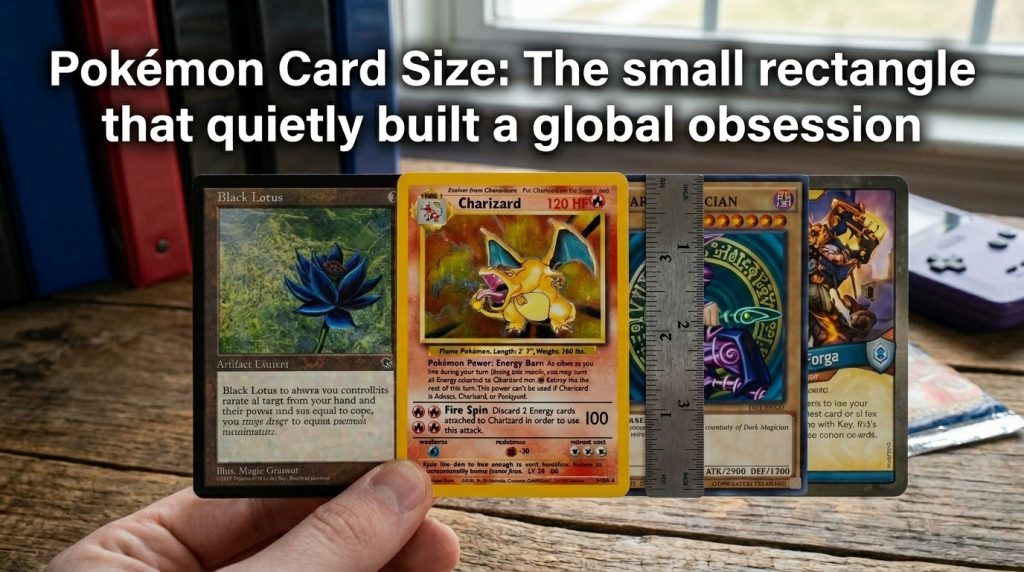
Now things get a bit interesting.
Most trading card games share the same general size, but not all of them feel the same.
- Magic: The Gathering cards stick closely to the same standard size as Pokémon, but often feel slightly thicker due to different printing finishes.
- Yu-Gi-Oh! cards are technically similar in footprint but often feel visually denser, like the text is trying to escape the card.
- KeyForge experiments more with design philosophy than physical size, but still respects the standard dimensions for compatibility.
So when people ask “Pokémon vs Magic card size,” the answer is technically: almost identical. But emotionally? Completely different universe.
Pokémon cards feel like childhood memories. Magic cards feel like strategy manuals disguised as art. Yu-Gi-Oh! feels like a dramatic argument happening in cardboard form.
Same size. Very different vibes.
Storage, sleeves, and the slightly obsessive world of card protection
Once someone owns even a handful of cards, they suddenly become very aware of storage physics.
Enter the world of:
- Card sleeves (penny sleeves, premium sleeves)
- Toploaders
- Card binders / pocket pages
- Binder pockets
- Polyethylene sleeves
- Polypropylene sleeves
Yes, it gets oddly scientific.
The standard Pokémon card sleeves size is designed specifically around the 2.5 × 3.5 inch frame. If even slightly off, you get curling, sticking, or that annoying corner bend that feels like heartbreak in physical form.
Collectors storing high-value cards say a holographic Charizard from the Base Set era often double sleeve, then place in a toploader, then into a binder. It’s like nesting dolls, but for cardboard treasure.
And don’t forget UV protection. Because apparently even sunlight has opinions about your collection.
Some people call it overkill. Others call it preservation. Both are probably right.
Collecting psychology: nostalgia, value, and why cardboard feels like gold
Here’s the strange part nobody warns you about: Pokémon cards don’t just sit in binders—they sit in memory.
The emotional attachment to collectibles is real. It’s tied to nostalgia effects, childhood experiences, and even social trading behavior. One day you’re swapping duplicates on a playground, the next you’re checking trading card auctions online like it’s a stock market.
The Pokémon card collecting guide communities often talk about “heart-value vs monetary value.” A beaten-up card from childhood might be worth nothing financially, but emotionally? It’s priceless.
And then there’s the market side:
- Rare Charizard price spikes
- Graded cards selling at auctions
- Long-term trading card investment market discussions
- Condition grading and card grading authenticity
A collector on a forum once wrote:
“I don’t collect Pokémon cards because they’re valuable. I collect them because they remember me.”
That sentence hits differently than it should.
Even collectible card durability plays into this. Cards age. Corners soften. Colors fade. And somehow that decay becomes part of the story.
Pokémon Card Size and the strange world of oversized cards
Not everything in Pokémon sticks to the standard.
There are Oversized Pokémon Cards (promo/collector format cards) that completely break the 2.5 × 3.5 rule. These can be around 5 × 7 inches or even larger, meant for display rather than play.
They’re not tournament legal, not sleeve-friendly, and definitely not practical. But they exist anyway, like postcards from an alternate Pokémon universe where everything is just… bigger for no reason.
They often appear in special sets, promotional events, or boxed collections. You’ll sometimes find them tucked inside an Elite Trainer Box (ETB) or premium set packaging.
They don’t shuffle. They don’t fit in binders. But they do look kinda majestic on a shelf, not gonna lie.
Authenticity, counterfeits, and the paranoia of perfect rectangles
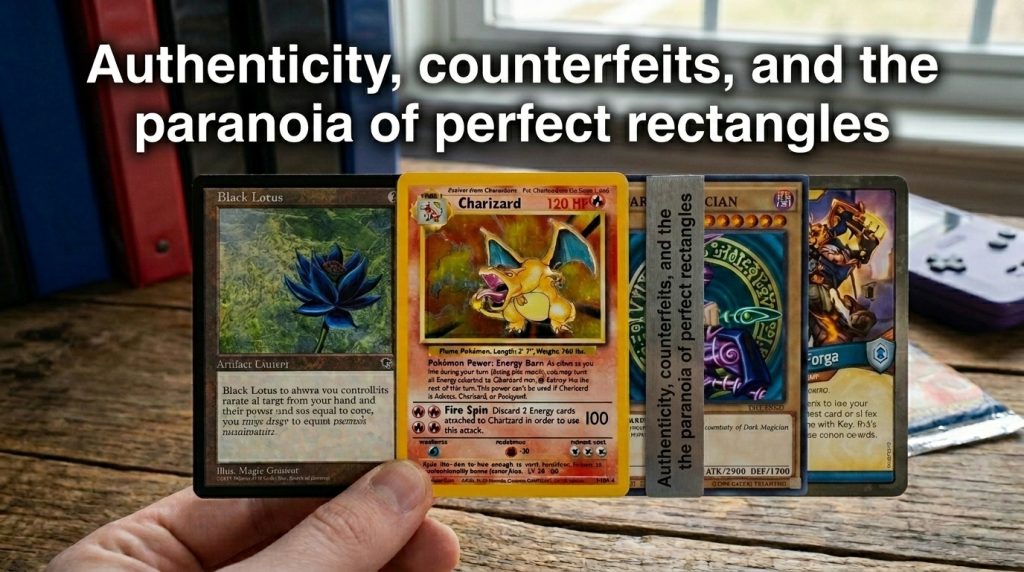
Whenever something becomes valuable, people start faking it. Pokémon cards are no exception.
Collectors look closely at:
- Card density consistency
- Cardstock quality verification
- Weight deviation detection
- Printing alignment and texture
The difference between real and fake can be subtle. Sometimes it’s the feel. Sometimes it’s the shine. Sometimes it’s just intuition collector instinct that says “this one’s off.”
Counterfeit detection is almost like a skill tree in itself. You don’t learn it once; you slowly develop it after seeing too many suspicious Charizards in too many shady listings.
And yes, counterfeiters also know the exact standard Pokémon card size, which makes the whole thing even more complicated.
Frequently asked Questions
pokemon card dimensions
Pokémon cards follow a standard size of 2.5 × 3.5 inches (63.5 × 88.9 mm), designed for consistent gameplay, storage, and compatibility with sleeves and binders.
pokemon card size
The official Pokémon card size is the same across all standard cards, ensuring they fit perfectly in decks, protectors, and trading card storage systems worldwide.
how big are pokemon cards
Pokémon cards are relatively small, about the size of a standard trading card, measuring 2.5 × 3.5 inches, which makes them easy to shuffle and collect.
what size are pokemon cards
Pokémon cards use a universal size of 2.5 × 3.5 inches, which is shared across most trading card games to maintain uniformity and usability.
size of pokemon cards
The size of Pokémon cards is standardized at 2.5 × 3.5 inches, a design choice that balances artwork visibility, handling comfort, and storage efficiency.
Read This Blog: https://prayersbloom.com/how-to-long-8-inches/
Conclusion: a tiny standard that holds a huge world together
At the end of it all, the standard Pokémon card size isn’t just a measurement. It’s a shared agreement across millions of players, collectors, and nostalgic humans who once believed a small piece of cardboard could change their day.
It shaped how decks are built in the Pokémon Trading Card Game, how collections are stored in binders, how markets value rarity, and how memories are physically held in hands.
There’s something quietly beautiful about that. A fixed rectangle, unchanged since the 1996 Base Set, still carrying new stories every day.
If you ever want to make a card feel more personal, don’t just look at its stats. Hold it. Notice the edges. Feel the thickness. Think about the fact that this exact size has been passed through thousands of hands, trades, battles, and childhood afternoons that probably smelled like old school desks and cheap snacks.
And if you’ve got your own favorite Pokémon card memory or that one card you still can’t believe you lost years ago—it’s worth sharing. People don’t usually forget those stories, even if they forget where they left their binders.

I’m SEO EXPERT, founder of Prayers Bloom and an AI-powered SEO & Content Writer with 6 years’ experience. I help websites rank higher, grow traffic, and stand out. I simplify SEO and web design to drive real results. Let’s grow your online presence together!